Gaussian splats
3D Tiles of Gaussian splats, as native Blender 5.3 splats
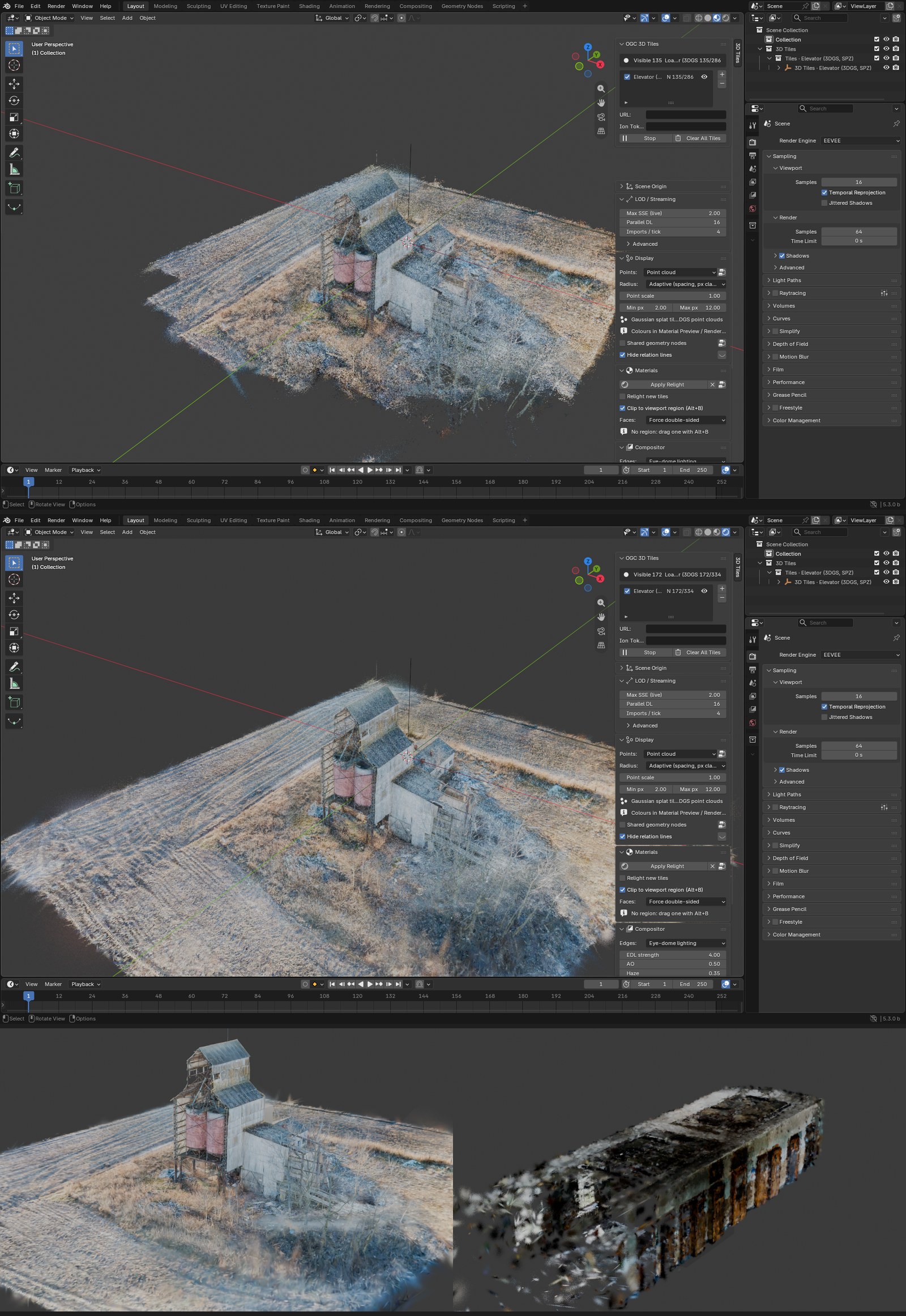
A tileset of Gaussian splats streams like any other: add its tileset.json and press Start. Coarse
splats show from far away, finer ones as you get closer.
- Blender 5.3 or newer: tiles are native Gaussian splats (release notes), drawn in Solid, EEVEE and Cycles.
- Older versions: the same tiles show as coloured points, with the usual point display.
- It needs the cesium-native backend.
Scene origin, clipping, rendering and converged animations work as for other tilesets. Raster overlays are not draped on splats.
Which tilesets
Tiles whose glTF uses KHR_gaussian_splatting, compressed with SPZ or not. That is what
3dtiled, the Cesium tilers and the
3DGS-PLY-3DTiles converter write. Tested with 3dtiled output and with the Elevator sample of the
3D-Tiles-RendererJS 3DGS plugin,
which has degree-3 spherical harmonics.
Tilesets without a location
Converters often write a splat tileset with no position on the globe. The add-on detects that at Start: the tileset keeps its own axes and metres, Z up, centred vertically, and the Scene Origin panel reads "Local tileset".
When the scene origin is already set (Custom, Keep, a place, or an earlier tileset with a location), such a tileset lands at the Blender origin. Move its root Empty to place it.
glTF extensions: honoured and ignored
What the add-on reads from a splat tile, through cesium-native, and what it leaves aside.
| Extension or attribute | Status | Notes |
|---|---|---|
KHR_gaussian_splatting attributes POSITION, COLOR_0, KHR_gaussian_splatting:ROTATION, KHR_gaussian_splatting:SCALE | Honoured | Colour and opacity come from COLOR_0; the node transform rotates and scales the splats; the older _ROTATION / _SCALE names are accepted too. |
KHR_gaussian_splatting:SH_DEGREE_n_COEF_m | Honoured | Degrees 1 to 3, in spec order, as radiance:sh_n. Degree 0 is the base colour. |
KHR_gaussian_splatting primitive fields kernel, colorSpace, projection, sortingMethod | Ignored | Blender draws its own kernel and sorts within each object. |
KHR_gaussian_splatting_compression_spz_2 | Honoured | cesium-native decodes the SPZ payload as stored, with no axis conversion: the converter's node matrix is what places the splats, as in the 3D-Tiles-RendererJS plugin. |
EXT_splat_opacity version 2 | Honoured | Draft extension of the 3DGS-PLY-3DTiles converter (William Liu). The converter merges splats into their coarse parents, which gives source opacities above 1; it then grows ("coverage boosts") the scales of those splats and clamps the opacity before writing SPZ, and records the source opacity and the pre-boost shape in this extension so a reader can undo the growth. The add-on removes the boost (the splats get their pre-boost scales back) and draws the source opacity, clamped to 1. Readers that ignore the extension, among them CesiumJS and the SPZ payload's own fallback, draw the grown splats, which look like soft blobs at coarse levels. The fraction of boost kept is SPLAT_COVERAGE_BOOST_KEPT in tileset/native_mesh.py, 0 by default. |
EXT_splat_opacity version 1 | Ignored | Legacy form with a display-ready float accessor; the SPZ values are used. |
KHR_materials_unlit | Not applicable | Splats carry no material. |
EXT_mesh_features, EXT_structural_metadata on splat tiles | Ignored | Read on mesh and point tiles only. |
Known limits
Blender sorts splats inside one object, not between objects. Where a coarse tile and the finer ones replacing it overlap for a moment, the blending between them can be wrong during that moment.
Not built, a possible way out without changing Blender: one splat object, a Geometry Nodes object that gathers every splat tile through a Collection Info node and Realize Instances, with the tile objects hidden, so Blender sorts all splats together. Re-realizing millions of splats whenever the tile set changes is too heavy while streaming, so it would be an opt-in for loaded tiles once streaming is stopped, or for a tileset copied to disk, and only if an artifact shows: most overlap lasts the moment a parent is swapped for its children.
How it works
- cesium-native decodes the SPZ payload; position, colour, opacity, rotation, scale and the spherical-harmonic coefficients go into the tile.
- The tile gets the shared
OGC3D SplatsGeometry Nodes group: Mesh to Points, then Set Point Cloud Type to 3D Gaussian Splat. - Attributes follow Blender's SPZ importer:
radiance:base(colour and opacity),scalein metres,rotationas a (w, x, y, z) quaternion,radiance:sh_nfor higher degrees. - Converter output often keeps its content under many levels of empty tiles, each with a smaller error than its parent. cesium-native would draw nothing at those levels, so the add-on gives such tiles their parent's error, which makes cesium-native refine through them.